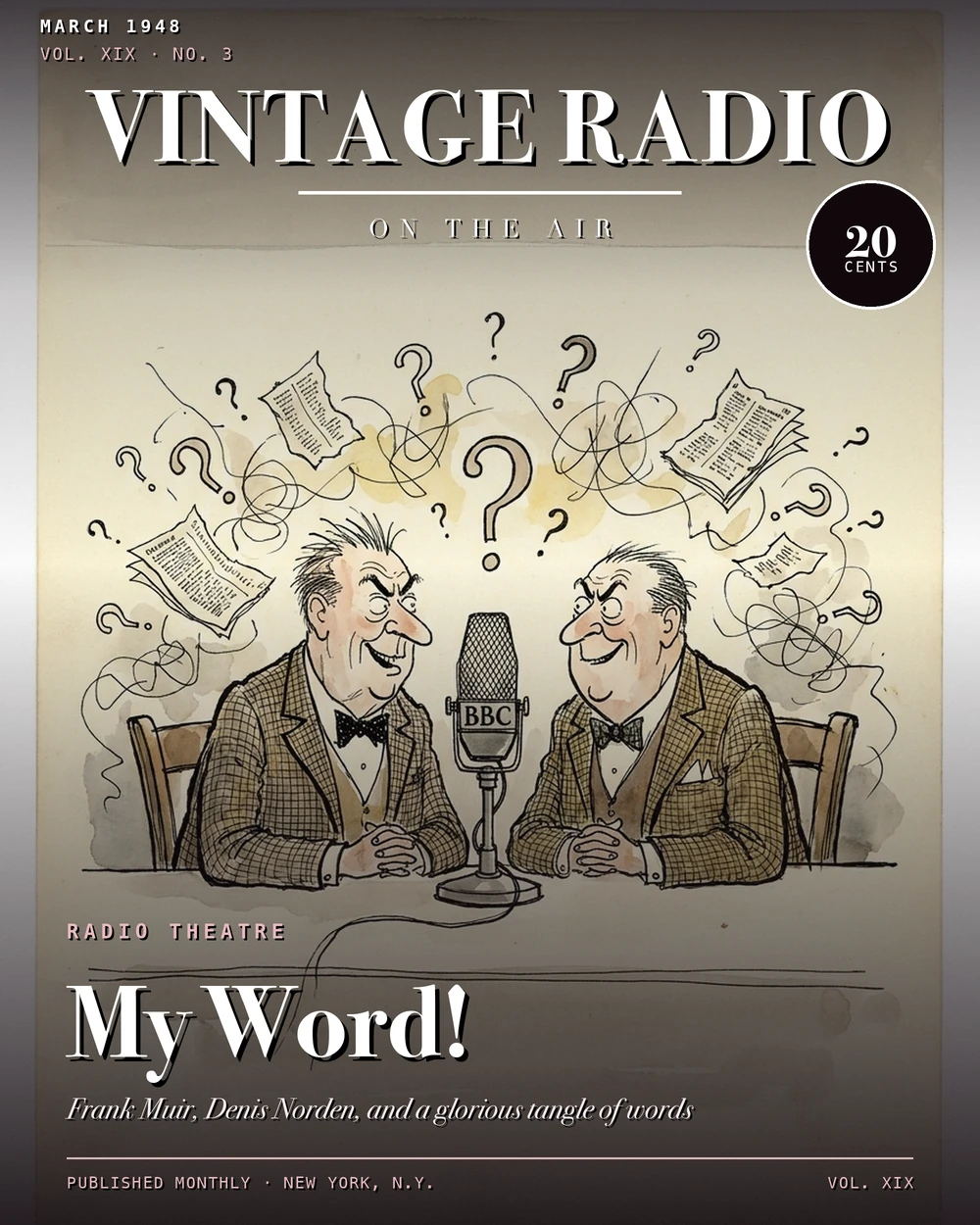
My Word!
How It Got Started
My Word! was created by Edward J. Mason and Tony Shryane — the writer and producer behind the BBC radio soap opera The Archers — who described their concept as "a new kind of not-very-academic literary quiz." The show was piloted in June 1956 on the BBC Midland Home Service and launched nationally on the BBC Home Service on 1 January 1957, where it would remain a fixture for more than three decades.
The two men brought to this project the same instinct for character and warmth that made The Archers work. They designed a format built around four panellists — always two men and two women — split into opposing teams and tested on vocabulary, etymology, poetry snippets, and the origins of phrases. The idea was a quiz that didn't feel like homework: sharp enough to reward genuine word knowledge, loose enough to let the funnier personalities run with a good line.
The man tasked with keeping order in that first series was cricket commentator and poet John Arlott, who was billed not as host or chairman but as "umpire" — a title that telegraphed exactly how seriously the show took its own competition. Arlott gave way to Jack Longland, who chaired for most of the programme's run. Later chairmen included John Julius Norwich and Michael O'Donnell, and Antonia Fraser took the chair for one series in 1987.
The Two Men Who Defined It
If one element made My Word! what it was, it was the pairing of Frank Muir and Denis Norden as permanent panellists and opposing team captains for the entire run from 1956 to 1988. Neither man started out thinking of himself as a performer. Both were drafted into the pilot as last-minute replacements when two planned panellists failed to appear, and they initially regarded themselves as writers who had stumbled into an awkward situation.
What happened instead was that the two men found a natural on-air chemistry that proved impossible to replicate or replace. Muir and Norden already knew each other well from writing partnerships in British comedy, and their ease with each other translated directly into the kind of banter the format required — witty without being cruel, competitive without being combative. They stayed in those chairs for thirty-two years and thirty-eight series.
The panellists who joined them over the decades included Isobel Barnett, E. Arnot Robertson, Dilys Powell, Nancy Spain, Anne Scott-James, and Antonia Fraser. The format kept two men and two women on the panel throughout, which gave each episode a consistent conversational texture even as the guest roster shifted.
The Shaggy-Dog Story That Accidentally Became the Show's Signature
The detail that made My Word! genuinely distinctive — and the one listeners remember most clearly — was the final round, in which Muir and Norden were each required to invent a shaggy-dog story purporting to give the "true" origin of a famous quotation or phrase, with the whole thing building toward a pun. This element was not planned. It arose by accident at the pilot recording and proved so well received that it became the programme's closing set piece for the rest of its run.
The stories themselves were elaborate, winding constructions that required both men to sustain a comic premise across several minutes before landing on a groan-worthy pun. The better ones required genuine craft: a pun that works at the end of a long story is a harder thing to construct than it sounds, and both Muir and Norden were skilled enough writers to build them reliably week after week. They later compiled five volumes collecting these stories, and a single-volume edition titled the Complete and Utter My Word! Collection was also published — evidence of how durable that material proved outside the broadcast context.
How Far It Traveled
Within two years of its national launch, the BBC was selling My Word! to more than thirty-five countries through BBC Transcription Services. At the time, that made it the most-heard radio programme in the world — a remarkable reach for a show built around English wordplay, etymology, and jokes that depended heavily on the sound of the language itself.
The programme ran for thirty-eight series, ending on 26 September 1988. It was also adapted for BBC Television in ten episodes broadcast from July to September 1960, though it remained primarily a radio programme. A companion show, My Music, launched in 1967 and ran until 1993, and in 1972 and 1973 the two programmes produced joint Christmas specials under the title "My Word! It's My Music."
After Mason's death in 1971, the task of setting questions passed to Jack Longland and later to Peter Moore. For the final 1988 series, chairman Michael O'Donnell took on both the chairman's role and the question-setting duties together.
What It Left Behind
My Word! ran for thirty-two years with the same two captains and never significantly altered its format, which says something about how well the original design worked. The combination of genuine word knowledge, relaxed competition, and the weekly invention of elaborate comic stories gave it a consistency that sustained listener loyalty across four decades of British broadcasting.
The show is acknowledged as an influence on later BBC panel game programmes, and retrospective surveys have frequently cited it among the strongest radio comedies of its era. The episode catalog runs to 279 entries, with titles that give a fair sense of the show's range — Victorian Vulgarisms, Ruthless Rhymes, Verbal Vagaries, Widdershins, Ufologist — a mix of the obscure, the comic, and the deliberately absurd that captures the tone the show maintained throughout its run.